
Reviewed · HISTORICAL TOURS
Historic Temples and City Guided Walking Tour in Chiang Mai
Chiang Mai’s old city is compact, but its temples tell very different stories. This three-hour walking tour takes you from the city’s oldest temple to its grandest ruined chedi, with stops at royal monuments, classic Lanna buildings, and a teak monastery. It is a smart way to get your bearings without spending half a day in a vehicle.
I like the route for two clear reasons. First, it links the major sights in a sensible westward walk, so you see how the walled center fits together. Second, the guides, including TwoTwo, Jen, Pang, and Tin, are praised for clear explanations, good English, humor, and patient answers. The main consideration is that entrance fees at Wat Phra Singh and Wat Chedi Luang are extra, and three hours on foot can feel warm in Chiang Mai’s midday heat.
In This Review
- Key points at a glance
- Why this walking route works so well
- Wat Chiang Man and the elephant-supported chedi
- Three Kings Monument and Chiang Mai’s civic center
- Wat Phra Singh and classic Lanna design
- Wat Phan Tao and the royal teak hall
- Wat Chedi Luang’s ruined monument
- What the $16 price really gives you
- Walking conditions and practical planning
- Who will get the most from this tour
- Should you book this Chiang Mai temple walk?
- FAQ
- How long does the Historic Temples and City Guided Walking Tour last?
- Where does the tour begin?
- Where does the tour finish?
- Which temples are included?
- Are temple entrance fees included?
- What is the group size?
Key points at a glance
- Wat Chiang Man begins the story: See the elephant-supported chedi at Chiang Mai’s oldest temple.
- Five important stops fit into one walk: The route covers Wat Chiang Man, Three Kings Monument, Wat Phra Singh, Wat Phan Tao, and Wat Chedi Luang.
- Lanna architecture gets proper attention: Compare a classic northern Thai temple with an almost entirely teak wooden hall.
- Guiding is the main value: TwoTwo, Jen, Pang, and Tin are associated with an informative, friendly style and strong English.
- Small groups keep questions manageable: A maximum of 10 people makes this more personal than a large city tour.
- The price is low, but two admission fees are separate: At $16, the tour is affordable, though you should budget for the two paid temple entries.
Why this walking route works so well
I like tours that give a city a clear shape rather than simply dropping you at a list of sights. This route starts in the northeastern part of Chiang Mai’s old city and finishes farther west near Wat Chedi Luang. You move through the historic center on foot, seeing how temples, public squares, and roads connect.
The sequence also has a useful rhythm. Wat Chiang Man offers a quiet, early look at the city’s origins. Three Kings Monument shifts the focus to civic history. Wat Phra Singh supplies the grand Lanna architecture, Wat Phan Tao brings you close to traditional teak construction, and Wat Chedi Luang finishes with scale and drama.
The tour is limited to 10 people. That matters in temple courtyards, where a large group can block entrances and make explanations hard to hear. A smaller group also gives you more room to ask why a roof is shaped a certain way, what a monument represents, or how a palace became a monastery.
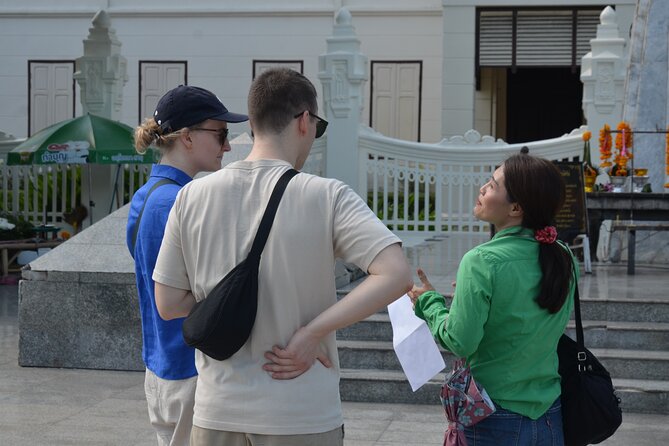
The guides are an important part of the experience. TwoTwo is noted for answering many questions and adding humor, while Jen is associated with strong English and an upbeat manner. Pang and Tin are also named as guides for this experience. The useful pattern is clear: this is not meant to be a silent stroll with a few dates attached. You get a guide who explains what you are looking at and checks that the group is following.
More historic sites in Chiang Mai:
- Chiang Mai: Historic Temples and City Guided Walking Tour
★ 4.7 · 650 reviews - Chiang Mai: Historic Old City Bike Tour – Morning or Night
★ 4.7 · 263 reviews - Chiang Mai: Historic Old City Bike Tour – Morning or Night
★ 5.0 · 202 reviews
Wat Chiang Man and the elephant-supported chedi
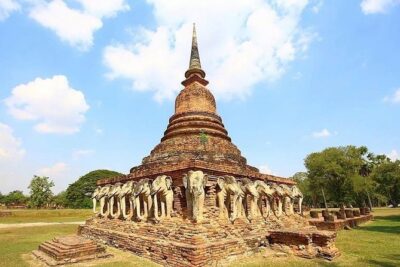
Your first stop is Wat Chiang Man, Chiang Mai’s oldest temple. The opening sight is its chedi ringed by 15 stone elephants, which appear to carry the structure on their backs. That detail gives the stop an immediate visual hook, especially if you are still trying to make sense of northern Thai temple design.
You have about 30 minutes here. That is enough time for the guide to explain the temple’s place in Chiang Mai’s beginnings and point out the parts that are easy to miss when you visit alone. The grounds also provide a calm start before the route moves into the city’s public heart.
Admission is free at this stop. That helps keep the basic tour price down and gives you a strong first sight without an extra payment.
Do not expect a long, private temple visit. The stop is one part of a tightly planned route, so the guide must balance explanation with movement. If Wat Chiang Man becomes your favorite temple, you may want to return later on your own and spend more time there.
Three Kings Monument and Chiang Mai’s civic center
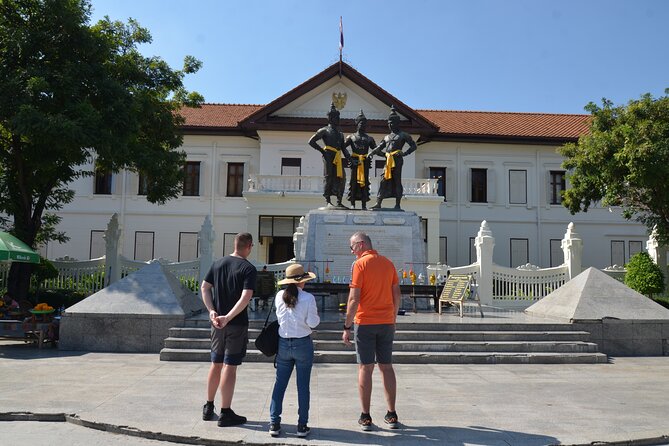
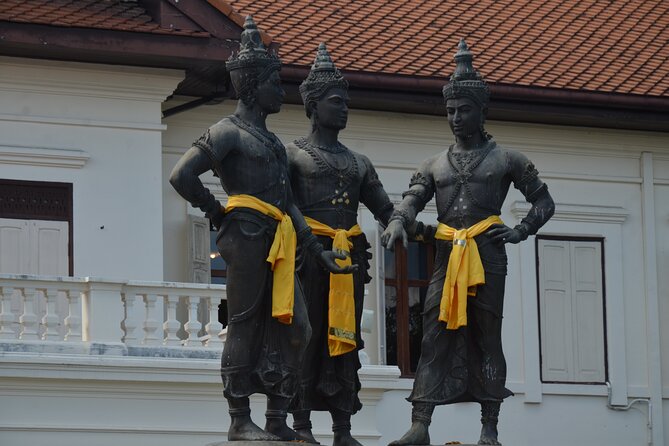
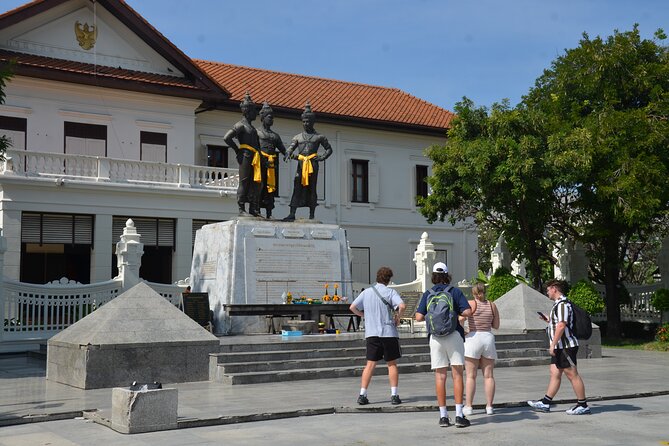
From Wat Chiang Man, the walk continues to Three Kings Monument. The monument sits in a large open square at the center of the walled old city, making it a useful place to understand Chiang Mai beyond its temple courtyards.
You get roughly 15 minutes here. The guide explains the history behind the statue and its cultural meaning, helping you connect the monument to the founding story of the city. The square also gives your eyes a break from detailed temple decoration and shows how the old city organizes its public spaces.
The short timing is both a strength and a limit. You get the essential context without lingering at a single monument, but this is not a full political history lesson. Think of it as a brief orientation stop that makes the rest of the walk easier to place.
This is also where a good guide can make a real difference. A statue in an open square can seem simple at first glance. The explanation gives it a role in the wider story of Chiang Mai and northern Thailand.
Wat Phra Singh and classic Lanna design
Wat Phra Singh receives the longest temple visit after Wat Chedi Luang, with about 50 minutes planned. It is described as one of the finest examples of classic Lanna architecture in northern Thailand, and that makes it a key stop for anyone interested in temple design.
Here, pay attention to the broad visual language of the building. Your guide can help you read the roof forms, decorative details, and layout instead of treating the temple as one more beautiful facade. The value of the stop is not only the photographs. It is learning what makes northern Thai architecture different from the styles you may see elsewhere in Thailand.
This is also the first stop where an entrance fee is not included. The exact amount is not given, so check the current charge when booking or before the visit. Bring enough Thai currency or another accepted payment method, since the tour price covers the guide and route, not every admission.
The 50-minute allocation is generous enough for explanation and unhurried viewing, but Wat Phra Singh can easily absorb much longer. If you want quiet time for prayer, detailed photography, or close study of every building, plan to return independently.
One useful feature of this stop is its contrast with Wat Phan Tao, which comes next. Wat Phra Singh gives you the polished, formal side of Lanna temple architecture. The next temple shows how powerful a smaller wooden building can feel.
More walking tours in Chiang Mai:
- Chiang Mai: 3 Hour Old City and Temples Guided Walking Tour
★ 4.6 · 1,568 reviews - Chiang Mai: Temple And City Walking Tour Part I
★ 4.7 · 244 reviews - Chiang Mai: Local Food and Markets Guided Walking Tour
★ 4.3 · 175 reviews - Chiang Mai Untouched Elephant: Nature Walk & Waterfall Trek
★ 4.7 · 77 reviews
Wat Phan Tao and the royal teak hall
Wat Phan Tao is one of the most distinctive stops because it is built almost entirely from teak wood. The temple dates to the 14th century and was originally used as a palace before becoming a monastery.
You have about 15 minutes here, so the guide will focus on the building’s strongest details. Inside the main hall is a huge teak throne once used by Chiang Mai’s rulers. That single fact changes how you see the room: it is not merely a wooden prayer hall, but part of a former royal setting.
This stop works best as a lesson in reuse and materials. After seeing the grander masonry and stucco forms at Wat Phra Singh, you encounter a building shaped by timber and royal history. The contrast makes both temples easier to remember.
The short visit may feel abrupt if you are drawn to wooden architecture. Still, it keeps the walking tour moving and avoids turning the middle of the morning into one long stop. The temple is free to enter, so there is no extra admission here.
Wat Chedi Luang’s ruined monument
The tour ends at Wat Chedi Luang Varavihara, where about 50 minutes are set aside. Its ruined chedi is the route’s biggest visual finish, and the majestic standing Buddha in the main prayer hall adds a more intimate counterpoint.
The chedi is impressive because its damaged condition is part of its character. You see a monument that has survived in an incomplete form, rather than a fully restored structure that looks new. Your guide can give the remains a historical frame and help you understand why this site carries such weight in Chiang Mai.
The standing Buddha shifts your attention from the huge exterior monument to the interior prayer hall. That change of scale is one reason the final stop feels complete. You get both a major architectural sight and a closer look at living religious space.
Wat Chedi Luang also requires an entrance fee that is not included. As with Wat Phra Singh, the tour information does not state the current amount. Treat the $16 price as the cost of the guided walk, bottled water, and interpretation, with two extra temple admissions to add.
Ending here is practical. You finish in the old city rather than having to retrace the entire route to the starting point. The endpoint is Wat Chedi Luang on Prapokklao Road, and the final stop gives you an easy place to continue exploring independently.
What the $16 price really gives you

At $16, this is an inexpensive guided introduction to Chiang Mai’s temple center. You are paying for a three-hour route, a guide, bottled water, and the convenience of seeing five significant places in one carefully ordered walk.
The strongest value comes from interpretation. You can visit all five locations on your own, but the experience would be more fragmented. A guide explains why Wat Chiang Man matters, links Three Kings Monument to the city’s story, compares Lanna buildings, and points out the royal past of Wat Phan Tao.
The price is not all-inclusive. You must pay separately for Wat Phra Singh and Wat Chedi Luang, and the exact admission charges are not provided. Even so, the tour remains a reasonable choice if you want historical context rather than simply collecting temple photographs.
The small maximum group of 10 improves the value. You are not paying for a private tour, but you get a setting where the guide can answer questions. That is especially useful if you are new to Thai Buddhism, northern Thai history, or temple etiquette.
Walking conditions and practical planning
The tour lasts approximately three hours and takes place on foot. There is no transport between stops, so comfortable shoes are more important here than stylish ones. The route is within Chiang Mai’s old city, but you should still expect outdoor walking and time spent standing in temple grounds.
The experience requires good weather. If poor weather cancels the tour, you are offered another date or a full refund. The same applies if the minimum number of participants is not reached.
You receive bottled water, which is a small but useful inclusion in a warm city. I would still plan your clothing with temple visits in mind, choosing respectful coverage for shoulders and knees and something comfortable for walking.
The meeting point is Wat Chiang Man at 171 Ratchapakhinai Road. The tour finishes at Wat Chedi Luang at 103 Prapokklao Road. Both points are near public transportation, and the end location is useful if you want to continue sightseeing in the old city after the guide says goodbye.
The tour is listed as suitable for most people, but the supplied details do not describe step-free access, seating breaks, or the exact walking distance. If you have mobility concerns, ask the provider before booking.
Who will get the most from this tour
I would choose this experience early in a Chiang Mai stay. It gives you a useful mental map and introduces the city’s main temple styles before you spend time exploring on your own.
It suits first-time visitors, history fans, architecture enthusiasts, and anyone who wants a short morning or afternoon activity. Families and couples may also appreciate the manageable three-hour length, especially when a guide can keep younger or less history-focused participants engaged.
The tour is a good fit if you want questions answered. The guides associated with it are described as patient, clear, and good-humored, with the ability to explain northern Thailand in accessible English.
It is less suitable if you want a slow, meditative temple visit with lots of free time. Five stops in three hours means the schedule is purposeful. You will see the highlights, but you may want to revisit one or two temples later.
A Sunday booking may add a local cultural touch. One Sunday group saw women performing traditional dances at the main temple. That is not guaranteed, but it shows how the timing of your visit can bring an unexpected local detail.
Should you book this Chiang Mai temple walk?
Book it if you want a low-cost, small-group introduction to Chiang Mai’s old city, especially at the start of your visit. The route is well chosen, the stops complement one another, and the guide adds the historical links that a self-guided walk often lacks.
Go in knowing that two temple fees are extra and that the pace is active. If you prefer a relaxed day with long periods at one site, choose a slower private visit instead.
For most people, the balance is favorable: five major sights, three hours, bottled water, a maximum of 10 participants, and guides such as TwoTwo, Jen, Pang, or Tin who can explain the details and handle questions. At $16, it is a practical way to meet Chiang Mai through its temples before setting off to explore the city on your own.
FAQ
How long does the Historic Temples and City Guided Walking Tour last?
The tour lasts approximately three hours.
Where does the tour begin?
It begins at Wat Chiang Man, 171 Ratchapakhinai Road, Si Phum, Chiang Mai.
Where does the tour finish?
The tour finishes at Wat Chedi Luang Varavihara, 103 Prapokklao Road, Si Phum, Chiang Mai.
Which temples are included?
The route includes Wat Chiang Man, Wat Phra Singh, Wat Phan Tao, and Wat Chedi Luang, along with Three Kings Monument.
Are temple entrance fees included?
The entrance fees for Wat Phra Singh and Wat Chedi Luang are not included. Wat Chiang Man, Three Kings Monument, and Wat Phan Tao list free admission.
What is the group size?
The tour has a maximum of 10 participants.
Just added around Chiang Mai
- Chiang Rai Wonders: White, Blue & Red Temples and Hot Spring★ 5.0 · 3 reviews
- Chiang Rai White Temple Blue Temple and Hill Tribe Village Tour★ 3.5 · 3 reviews
- Private Chiang Mai City Tour including Wat Doi Suthep, Wat Suan Dok (SHA Plus)★ 5.0 · 3 reviews
- Workshop Making Herbal ball & herbal inhaler★ 4.3 · 3 reviews
- Chiang Mai Mae Ping River Cruise and Thai Farmer House Visit★ 4.0 · 3 reviews
- Phoenix Zipline Adventure Park – Chiang Mai Thrills★ 4.0 · 3 reviews
- Monk trails hike, Wat Phalat, Monk chanting, Wat Doi Suthep.★ 5.0 · 3 reviews
- Tok Sen Massage at Fah Lanna Spa in Chiang Mai★ 4.5 · 3 reviews
Historical Tours, compared.
1 Day Sukhothai Historical Park from Chiang Mai Private Tour
Read our review →
Old Town History and Culture Walking Tour at Chiang Mai
Read our review →
Browse the lists this tour appears in