
Reviewed · CHIANG MAI OLD CITY TOURS
Old Town History and Culture Walking Tour at Chiang Mai
Chiang Mai’s old town makes the most sense on foot, and this tour gives you a clear route through its royal beginnings and two important temples. I like the opening at the Three Kings Monument, where the guide explains King Mangrai and the founding of the Lanna Kingdom before the walk begins. I also like the small maximum of eight people, which should make it easier to hear and ask questions.
The price is a modest $15, with temple entrance fees, bottled water, and travel insurance included. The main caution is guide quality: most of the published feedback is strongly positive, but one experience had serious problems with English, repetition, and organization. The tour is also an old-town walking route, not a broad city tour with hotel transport.
In This Review
- Key points at a glance
- Why this short walk works well in Chiang Mai
- Starting beneath the Three Kings Monument
- Wat Phra Singh and the details of Lanna design
- The walk to Wat Chedi Luang
- Wat Chedi Luang and the great ruined chedi
- What the $15 price really covers
- Guide quality and the small-group difference
- Who should book this Chiang Mai walking tour?
- Should you book it?
- FAQ
- How long does the Chiang Mai walking tour last?
- Where does the tour begin?
- Where does the tour end?
- Which temples are included?
- Is the Three Kings Monument included in the tour?
- Are temple entrance fees included?
- Is hotel pickup included?
- How large is the group?
- Can I cancel for a full refund?
Key points at a glance
- Three Kings Monument opening: Begin with a safety briefing and an introduction to King Mangrai, the first king of the Lanna Kingdom.
- Two major temples: Spend about an hour at Wat Phra Singh and another hour at Wat Chedi Luang.
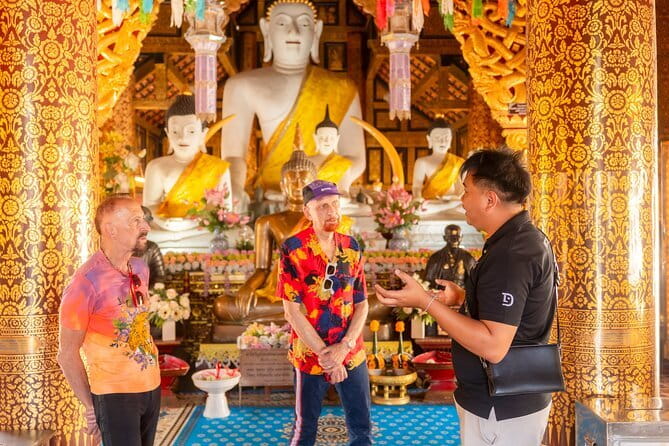
- Lanna art and architecture: See the Lai Kam assembly hall, murals, pagodas, and the great ruined chedi.
- Small group format: The group is limited to eight people, a useful size for a walking tour and temple talks.
- Simple $15 value: Entrance fees, English-speaking guiding, bottled water, and travel insurance are included.
- One-way old-town route: Start at the Three Kings Monument and finish at Wat Chedi Luang, with no hotel pickup or drop-off.
Why this short walk works well in Chiang Mai
Chiang Mai can feel easy to explore at first. The old town is compact, and the main temples sit within a manageable area. Yet the buildings do not explain themselves. A carved image, a ruined chedi, or a painted hall means more once you understand the Lanna kingdom and the religious life that shaped the city.
This 2.5-hour walk gives you that basic framework without taking up half a day. You meet at the Three Kings Monument, visit Wat Phra Singh, then continue to Wat Chedi Luang. The route has a useful sense of progress: political origins first, living religious art next, and a huge historic ruin at the finish.
I like the way the tour keeps its subject focused. You are not being driven from one distant sight to another. You stay in the old town and move at walking pace, which lets the guide connect the monuments instead of presenting them as unrelated photo stops.
The group limit of eight matters here. Temple courtyards can be busy, and a large crowd makes explanations hard to follow. A small group should give you a better chance to hear the guide and ask about details that catch your eye.
More Old City walks in Chiang Mai:
- Chiang Mai: 3 Hour Old City and Temples Guided Walking Tour
★ 4.6 · 1,568 reviews - Chiang Mai: Thapae Boxing Stadium Muay Thai Match Ticket
★ 4.5 · 457 reviews - Chiang Mai: Historic Old City Bike Tour – Morning or Night
★ 4.7 · 263 reviews
Starting beneath the Three Kings Monument
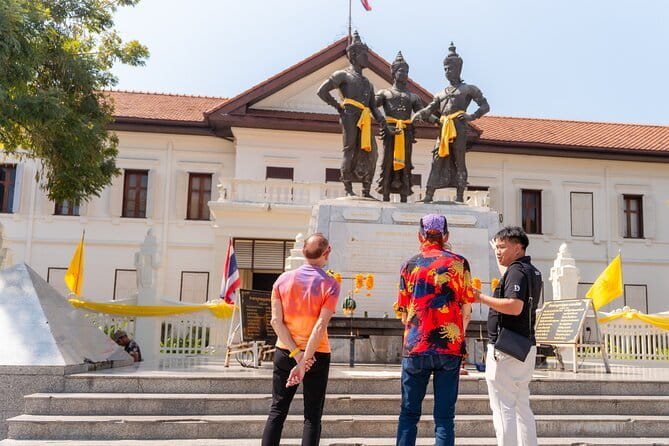
The tour begins at the Three Kings Monument on Prapokklao Road. The monument gives the walk an appropriate starting point because the opening talk centers on King Mangrai, the first king of the Lanna Kingdom and founder of Chiang Mai.
You receive a short safety briefing before the historical explanation. That may sound basic, but it sets expectations for a walking tour and gives the guide a chance to organize the group before moving through the old town.
The monument features King Mangrai in the middle, with two other historic figures beside him. The guide uses the site to explain Chiang Mai’s beginnings and the importance of the Lanna period. I find this introduction useful because it gives you names and a political setting before you enter the temples.
Allow a little time to find the meeting point. The listed location is Three Kings Monument, QXRP+3WX, Prapokklao Road, in the Si Phum area of Chiang Mai. The tour does not include hotel pickup, so you need to reach the monument yourself.
This first stop lasts about 30 minutes and has no admission charge. It is not simply a gathering point. It provides the historical spine for everything that follows.
Wat Phra Singh and the details of Lanna design
The first temple visit is Wat Phra Singh, described as the second most revered temple in Chiang Mai. The complex dates to 1346 and is a strong example of Lanna architecture, the regional style associated with northern Thailand.
You spend about an hour here, so this is not a quick stop for one photograph. The main points include the Lai Kam assembly hall and a pagoda. The assembly hall contains detailed murals, which give the guide something concrete to explain rather than relying only on dates and royal names.
The tour also points out the importance of the hall and pagoda for people born in the Year of the Dragon. That detail adds a personal layer to the visit. Even if you were not born under that sign, it helps show how temple meaning can connect with everyday belief and identity.
One of the tour’s best features is the chance to ask about Thai Buddhism in a setting where its practices are still active. A guide such as Khun Bim, praised for clear English and thoughtful explanations of Theravada Buddhism, can make this part especially useful for anyone who already knows something about Buddhism but wants to understand the Thai tradition better.
The quality of the guide matters most at Wat Phra Singh. The architecture is impressive on its own, but a short explanation about the murals, the hall, or the temple’s place in Chiang Mai’s religious life can turn a viewing stop into a learning experience.
Keep your expectations realistic. The supplied details do not promise every hall will be open or that every mural will receive a detailed art lecture. You will get a guided visit, not an academic seminar. Still, an hour is enough time for a measured look rather than a rushed circuit.
The walk to Wat Chedi Luang
After Wat Phra Singh, the group takes a short walk to Wat Chedi Luang Varavihara. This transition is part of the value. You move through the old town rather than watching it pass through a vehicle window.
The distance is described as a short stroll, but the tour remains a walking activity for its full duration. Wear shoes you can use comfortably for at least two and a half hours, and consider the local weather when choosing clothing. The supplied details do not specify a dress code, so check current temple expectations before you go.
The second temple receives about an hour. That equal timing gives Wat Chedi Luang proper attention instead of treating it as a final five-minute stop.
More historic sites in Chiang Mai:
- Chiang Mai: Historic Temples and City Guided Walking Tour
★ 4.7 · 650 reviews - Chiang Mai: Historic Old City Bike Tour – Morning or Night
★ 5.0 · 202 reviews - Chiang Mai: Private Historic Old City Bike Tour – Night
★ 4.7 · 143 reviews - Chiang Mai: Historical and Culture Exploration Walking Tour
★ 4.6 · 40 reviews
Wat Chedi Luang and the great ruined chedi
Wat Chedi Luang is a 14th-century temple complex known for the remains of a massive chedi. The site has a different feel from Wat Phra Singh. At the first temple, you focus heavily on a functioning religious complex, Lanna design, and painted interiors. At Chedi Luang, the scale and damaged remains make the past more visible.
The chedi is central to the visit, and the complex also remains popular with local people and tourists. Restoration work in the 1990s, associated here with UNESCO, helped preserve the site. That detail is worth noting because the ruins are not simply left to weather away. What you see is shaped by both age and conservation.
The temple is also linked with the remains of a major religious object, making it an important stop in Chiang Mai’s story. The supplied description does not specify every object or chamber you will see, so the guide’s live explanation will shape how much detail you receive.
A particularly valuable feature is the chance to listen to talks by monks before the tour ends. This is not just another historic building explanation. It offers contact with living religious practice, and it can help you understand the difference between seeing a Buddhist temple as a monument and seeing it as a place used for belief, teaching, and community life.
One thoughtful detail from the tour is that a monk’s blessing may be offered, but you are asked in advance if you want to take part. That is good practice. You can appreciate the custom without feeling pushed into a religious activity that does not suit you.
The tour ends at Wat Chedi Luang, at 103 Prapokklao Road. This location is useful if you want to continue exploring the old town afterward, but you are responsible for arranging your own return transport.
What the $15 price really covers
At $15 per person, this is an inexpensive way to add structure to a first look at Chiang Mai’s old town. The ticket includes admission fees at the two temples, an English-speaking guide, bottled water, and travel insurance.
That matters because temple entrance charges can make a supposedly cheap outing less cheap once added together. Here, the basic costs are bundled, and you do not need to manage tickets while keeping up with the group.
The value is strongest if you want context. You can walk past these monuments on your own for no guide fee, but you may not learn why the Three Kings Monument matters, how Lanna design appears at Wat Phra Singh, or why the ruined chedi at Wat Chedi Luang is so important.
At least one departure also included donations and fried bananas, but those extras are not listed among the standard inclusions. Treat them as possible additions, not something guaranteed by the $15 price.
The tour does not include hotel pickup or drop-off. That keeps the price low, but it means you need to reach the starting point and make your own way onward from Wat Chedi Luang.
Guide quality and the small-group difference
The strongest feedback focuses on friendly guides, clear English, good timing, and useful cultural explanations. Guides named in the feedback include Kitty and Khun Bim. Khun Bim received particular praise for explaining Thai Theravada Buddhism in a way that added something even for someone with long experience of another Buddhist tradition.
Several qualities matter here: the walk starts and finishes on time, the pace is neither rushed nor slow, and the information remains interesting. That combination is more important than a guide who simply recites dates.
Still, you should know that guide performance can vary. One departure had problems with communication, repeated explanations, and organization. The operator apologized and said it would work on guide training, equipment, and preparation. A maximum of eight people should help, but it cannot guarantee the same guide style on every date.
I would book this with the expectation of a solid introductory walk, not a private specialist tour. If you want deep architectural analysis or extensive time at every temple, you may find the format limited. If you want a friendly orientation with the main old-town sights, the design makes good sense.
Who should book this Chiang Mai walking tour?
This tour suits you if it is your first stay in Chiang Mai and you want the old town to make sense quickly. It also fits anyone who prefers a short guided visit over a full-day excursion.
You will get the most from it if you enjoy history, religious art, and hearing how a place is used today. The monk talks and optional blessing add a cultural element that is not always included in a basic sightseeing walk.
It is also a good choice if you want to avoid the planning work of comparing temple entrance fees and building your own route. The guide handles the sequence, while you focus on the sites.
You may want something else if you dislike walking, need hotel transport, or want to see a wider range of Chiang Mai beyond the central old town. This experience stays within a small section of the city and finishes at the second temple.
The tour is open to most people, according to the supplied participation details, and it is near public transportation. Confirmation arrives at booking, and free cancellation is available up to 24 hours before the start time. Changes or cancellations inside that window are not accepted for a refund.
Should you book it?
Book this tour if you want a low-cost, compact introduction to Chiang Mai’s royal origins, Lanna temple design, and living Buddhist practice. The combination of the Three Kings Monument, Wat Phra Singh, and Wat Chedi Luang gives you a sensible first route through the old town.
The price is strong because tickets, water, insurance, and guiding are included. The small group and generally praised pace add to the appeal. Just keep the guide-quality caveat in mind, and do not expect hotel transport or a full-city tour.
For a first afternoon in Chiang Mai, I would consider it a practical choice. Afterward, you finish at Wat Chedi Luang with the rest of the old town still available to explore at your own pace.
FAQ
How long does the Chiang Mai walking tour last?
The tour lasts approximately 2 hours and 30 minutes.
Where does the tour begin?
It begins at the Three Kings Monument on Prapokklao Road in Chiang Mai’s Si Phum area.
Where does the tour end?
The tour ends at Wat Chedi Luang Varavihara, at 103 Prapokklao Road.
Which temples are included?
The route includes Wat Phra Singh and Wat Chedi Luang Varavihara. It also begins with an introduction at the Three Kings Monument.
Is the Three Kings Monument included in the tour?
Yes. The guide meets the group there, gives a safety briefing, and explains King Mangrai, the first king of the Lanna Kingdom and founder of Chiang Mai. There is no admission charge for this stop.
Are temple entrance fees included?
Yes. All entrance fees are included in the tour price.
Is hotel pickup included?
No. Hotel pickup and drop-off are not included. You need to reach the Three Kings Monument yourself and arrange onward transport after the tour.
How large is the group?
The tour has a maximum of eight participants.
Can I cancel for a full refund?
Yes, if you cancel at least 24 hours before the experience start time. Cancellations or changes made less than 24 hours before the start are not accepted for a refund.
More Walking Tours in Chiang Mai
- Chiang Mai: Temple And City Walking Tour Part I
★ 4.7 · 244 reviews - Chiang Mai: Local Food and Markets Guided Walking Tour
★ 4.3 · 175 reviews - Chiang Mai Untouched Elephant: Nature Walk & Waterfall Trek
★ 4.7 · 77 reviews - Chiang Mai Old City & Temples Guided Walking Tour – 3 Hrs
★ 4.5 · 34 reviews
Just added around Chiang Mai
- Chiang Rai Wonders: White, Blue & Red Temples and Hot Spring★ 5.0 · 3 reviews
- Chiang Rai White Temple Blue Temple and Hill Tribe Village Tour★ 3.5 · 3 reviews
- Private Chiang Mai City Tour including Wat Doi Suthep, Wat Suan Dok (SHA Plus)★ 5.0 · 3 reviews
- Workshop Making Herbal ball & herbal inhaler★ 4.3 · 3 reviews
- Chiang Mai Mae Ping River Cruise and Thai Farmer House Visit★ 4.0 · 3 reviews
- Phoenix Zipline Adventure Park – Chiang Mai Thrills★ 4.0 · 3 reviews
- Monk trails hike, Wat Phalat, Monk chanting, Wat Doi Suthep.★ 5.0 · 3 reviews
- Tok Sen Massage at Fah Lanna Spa in Chiang Mai★ 4.5 · 3 reviews
Chiang Mai Old City Tours, compared.
3 Hour Old City and Temples Guided Walking Tour
Read our review →

Highlights & Hidden Gems With Locals: Best of Chiang Mai Private Tour
Read our review →

Browse the lists this tour appears in