
Reviewed · THAI COOKING CLASSES
Cooking class in organic garden and local market tour ThaiCottage
The best part of this Chiang Mai cooking class is that you do not simply watch a chef work. You pound curry paste from scratch, choose dishes you actually want to eat, and cook them at your own station in an organic garden kitchen with a Thai family. The market visit adds useful context before the first chop and stir.
I like the small maximum group of eight and the choice of dishes, which make the class feel more personal than a fixed menu lesson. I also like that hotel pickup, ingredients, water, instruction in English, and an online recipe book are included. The market stop may be fairly independent, and some preparation is done ahead of time, so ask how much hands-on work your session will include.
In This Review
- Key points to know before booking
- A four-hour food lesson with a real sense of place
- Pickup from central Chiang Mai
- The market stop: useful ingredients, limited tour structure
- From market produce to the organic herb garden
- Choosing your own Thai menu
- Grinding curry paste the old-fashioned way
- Cooking at your own station
- Mango sticky rice and the sweet finish
- Eating what you prepared
- Is $35.86 a good value?
- Who will enjoy this class most?
- Booking, cancellation, and small practical details
- Should you book Thai Cottage Home Cookery School?
- FAQ
- How long does the cooking class last?
- Is hotel pickup included?
- How many people can join the class?
- Do I visit a local market?
- Does the class include an organic garden visit?
- Can I choose which dishes to cook?
- Will I learn to make curry paste?
- Is mango sticky rice included?
- What happens if bad weather cancels the class?
Key points to know before booking
- Make your own curry paste: Learn how fresh herbs and spices become the base of a Thai curry.
- Choose your menu: Options typically cover soup, stir-fry, curry, and dessert, rather than forcing one set meal on everyone.
- Start at a local market: See the ingredients used in everyday Thai cooking before heading to the garden.
- Cook at an individual station: You get direct practice instead of standing behind a demonstration crowd.
- Finish with mango sticky rice: Everyone learns the Thai sweet sticky rice dessert as part of the class.
- Pickup has a limit: Round-trip hotel transfer is included only for hotels within 3 kilometers of Chiang Mai’s city area.
A four-hour food lesson with a real sense of place
Thai Cottage Home Cookery School offers a practical half-day outing rather than a formal culinary course. You spend about four hours moving from hotel pickup to market, garden, cooking station, and shared meal.
That pace suits you if you want to learn a few useful techniques without giving up an entire day of sightseeing. It also makes this a good choice early in a Chiang Mai visit, since the market and garden help you recognize ingredients you may see again in restaurants and food stalls.
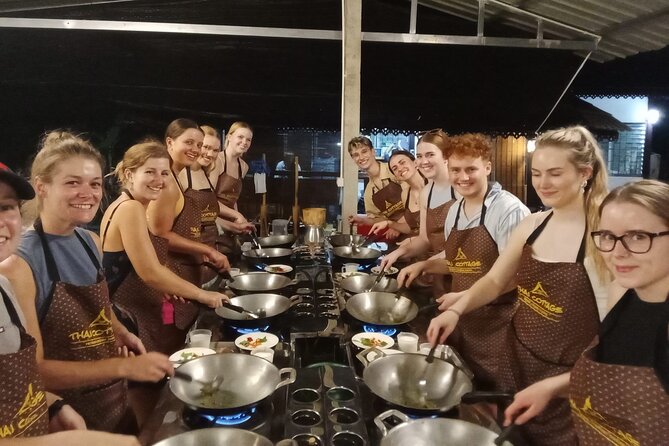
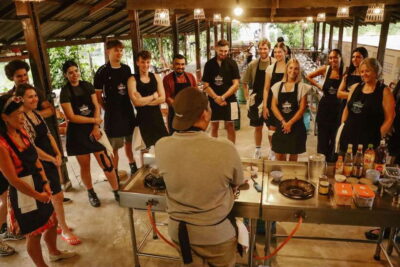
The class is designed for a maximum of eight people. That number matters. You are less likely to be lost at the back of a large demonstration, and the instructor can watch your chopping, grinding, and frying more closely.
The instructors named in the feedback include Toey, Kat, Mac, Wave, and Gataii. The exact teacher depends on the date, but the teaching style appears to be friendly, patient, and well organized. English instructions and an online PDF recipe book make it easier to repeat the dishes after returning home.
More Thai cooking classes in Chiang Mai:
- Half-Day Thai Cooking Class at Organic Farm in Chiang Mai
★ 5.0 · 19,087 reviews - Chiang Mai: Cooking Class, Market & Thai Herbs Garden Tour
★ 4.9 · 4,824 reviews - Chiang Mai: Authentic Cooking Class with Market & Farm Visit
★ 4.9 · 4,546 reviews
Pickup from central Chiang Mai
The day begins with round-trip hotel transportation. This is a useful inclusion in Chiang Mai, where a short-looking trip can take longer in traffic and where finding a cooking school outside the main tourist streets may be a nuisance.
There is one important limit: pickup is included only within 3 kilometers of the city area. If your hotel sits farther out, confirm the meeting point and any extra transport arrangements before booking. Do not assume every Chiang Mai hotel qualifies.
The transfer also keeps the four-hour schedule tidy. You do not have to arrange a songthaew or taxi before breakfast, and you can return directly to your hotel after the meal and recipe discussion.
The market stop: useful ingredients, limited tour structure
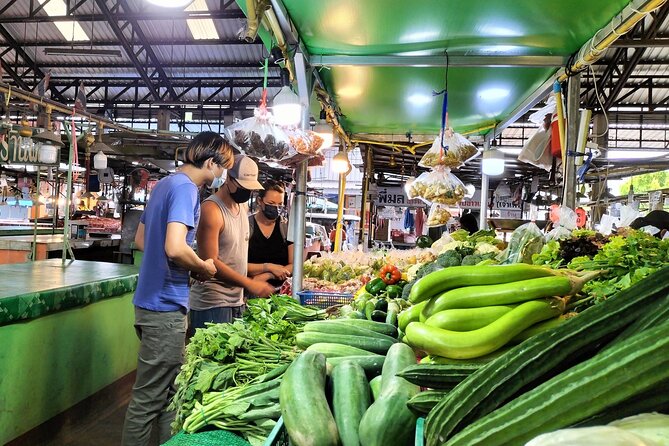
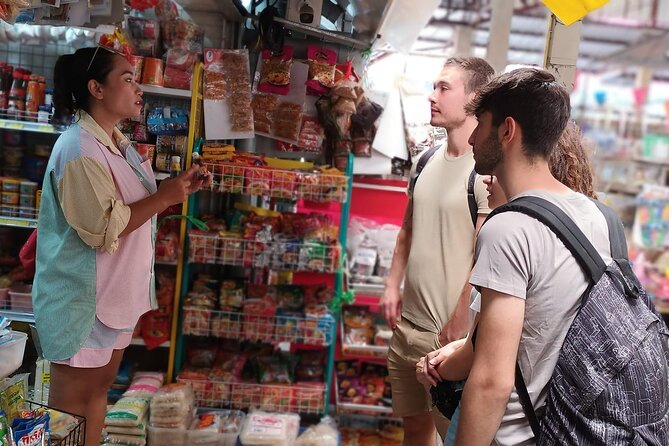
The first stop is a local market. This gives you a look at the produce and pantry items used by the surrounding community, including the herbs, vegetables, and other ingredients that appear in Thai cooking.
The value here is practical. Thai ingredients can be hard to identify when you see them piled together in a market or listed under unfamiliar English names. A guide can connect the raw ingredient to the dish you will later cook, which makes the lesson more memorable than reading a recipe alone.
Set your expectations correctly. The market portion may not be a full guided shopping tour. Some sessions give you time to look around with only brief explanations, and the ingredients may already be arranged for the class rather than purchased as a group at the market.
That is not a deal breaker, especially if you have never visited a Thai market. But if your priority is a detailed food walk with extensive bargaining, vendor conversation, and ingredient buying, this class may feel light on that part. The cooking lesson is the main event.
From market produce to the organic herb garden
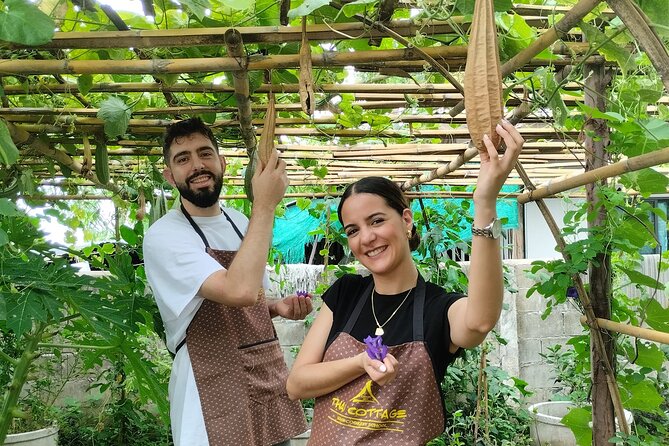
After the market, you continue to an organic garden where you see herbs and vegetables used in the recipes. This is one of the class’s more appealing features because it links Thai food to the plants themselves.
You are not only told that a dish contains herbs. You can see what those herbs look like before they are chopped, crushed, or stirred into a curry. That connection is especially helpful with Thai flavors, where a few fresh leaves, roots, or stalks can change the entire character of a dish.
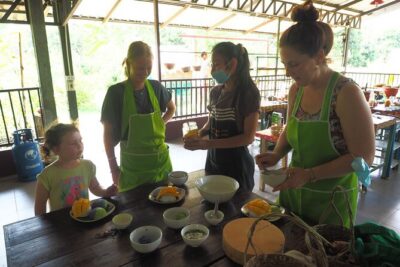
The garden also gives the class a more relaxed setting than a restaurant kitchen. Cooking takes place in a covered outdoor kitchen garden, with each person given a work area. Bring a light, comfortable outfit, since garden cooking can feel warmer than sitting inside an air-conditioned school.
Same city, a completely different sort of day:
- Chiang Mai: Elephant Sanctuary, Waterfall & Bamboo Rafting
★ 4.9 · 9,160 reviews - Chiang Mai: Doi Inthanon National Park Eco-Friendly Tour
★ 4.6 · 6,667 reviews - Chiang Mai: Elephant Sanctuary & Waterfall Group Tour
★ 4.9 · 5,780 reviews - Chiang Mai: Chiang Rai Temples, Karen Tribe and Hot Springs
★ 4.7 · 5,401 reviews
Choosing your own Thai menu
Choice is a major reason to book this class. Instead of handing everyone the same menu, the instructor lets you select dishes from several categories. The options described in the class include soup, stir-fry, curry, and dessert.
This works well for mixed groups. One person can choose a curry while another chooses a stir-fry, and a family can divide the menu so everyone learns something different. It also helps if you already know which Thai dishes you love or if you want to avoid a particular ingredient.
The exact dish count needs a little clarification. The class description says you can choose six Thai dishes from different categories, while several accounts describe a four-dish format: one soup, one stir-fry, one curry, and one dessert. Another description refers to choosing three dishes plus dessert.
For that reason, ask the operator what your date includes before you arrive. The consistent part is the range of choices and the required lessons in curry paste and sticky rice. The number of individual dishes may depend on the session or how the menu is explained.
Grinding curry paste the old-fashioned way
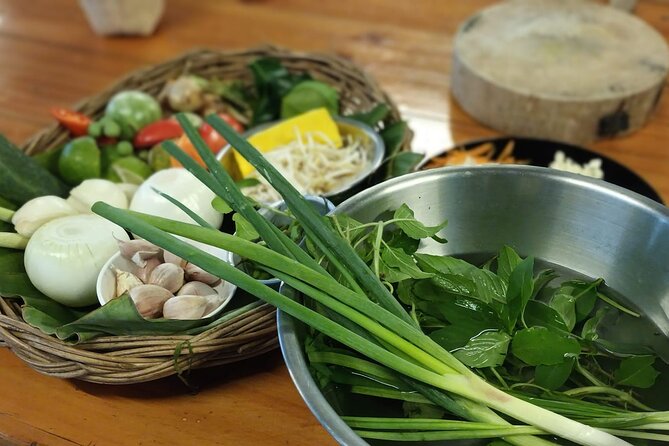
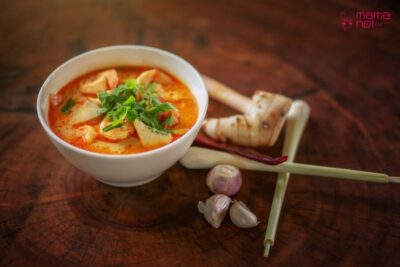
Making curry paste is the hands-on centerpiece. You work with fresh ingredients and learn how the paste is built rather than opening a prepared jar.
This step teaches something important about Thai cooking: curry is not just a sauce poured over meat or vegetables. The flavor begins with the paste, and the balance of herbs and spices matters. Grinding the ingredients also gives you a better sense of texture and aroma than a quick demonstration would.
The instructor guides you through the process, and the small group makes it possible to ask questions. Teachers such as Toey and Mac received special praise for keeping the group moving while still helping people with different skill levels.
You should not expect a professional chef qualification from a four-hour lesson. You will, however, leave with a repeatable method and a recipe you can try at home. That is the right standard for this kind of activity.
Cooking at your own station
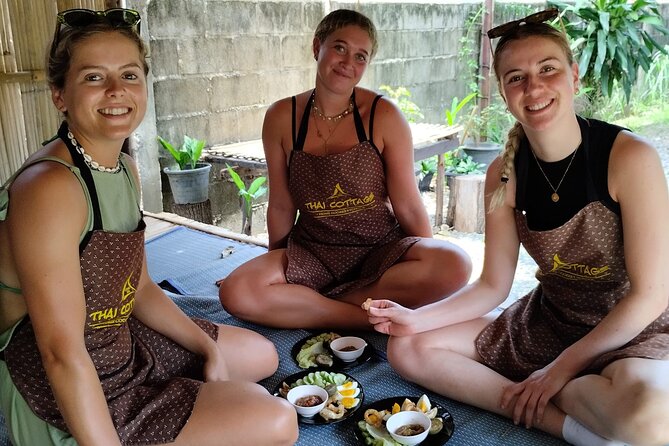
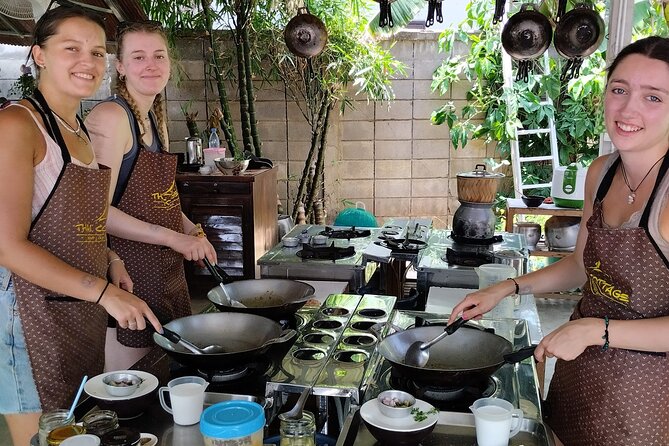
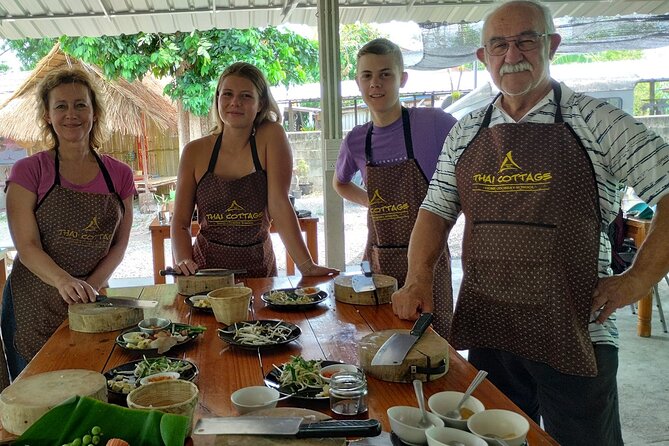
The covered kitchen is set up so each person can cook rather than simply watch. You prepare the chosen dishes with instruction, then eat what you have made in a traditional Thai family-style setting.
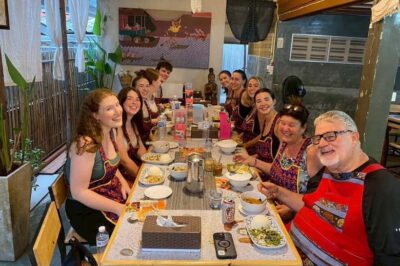
This format gives the class a social side. You cook beside other people, compare your choices, and sit down together afterward. Some sessions include a lively mix of nationalities and language levels, but instructors are used to keeping the group together.
The organization appears to be one of the class’s strongest points. Assistants clean and reset between dishes, which prevents the workstations from becoming cluttered. Teachers keep an eye on timing so that soup, stir-fry, curry, and dessert arrive in a sensible order.
There is a small tradeoff. Some ingredients may be washed, cut, or partly cooked before you begin. Rice and certain vegetables may already be prepared, and meat may already be sliced. This keeps the class within four hours and makes the meal easier to manage, but it means you may not prepare every ingredient from start to finish.
If you want a lesson focused on knife skills, ask how much chopping and preparation you will do. If you want an efficient class that gets you cooking and eating without delays, the advance preparation is helpful.
Mango sticky rice and the sweet finish
Everyone learns to make sticky rice for the traditional mango dessert. It is a welcome part of the schedule because many cooking classes focus almost entirely on savory food.
Sticky rice with mango also shows how Thai desserts rely on texture and balance. The soft rice, coconut flavor, and fruit make a simple finish to a meal built around stronger curry and herb flavors.
The dessert is prepared as part of the class rather than treated as an afterthought. By the end, you have covered several core parts of a Thai meal: soup, stir-fried food, curry, and something sweet.
Eating what you prepared
The final meal is the payoff, and it is also a useful test of the instruction. You sit down with the group and eat the food prepared during the class.
Fresh ingredients, clear recipes, and close guidance matter here. A dish can taste good in a restaurant because a professional cook has corrected every balance of salt, sourness, sweetness, and heat. In this class, you get a better sense of how those elements come together under your own hands.
The food is frequently described as delicious, but keep in mind that your results depend partly on your own cooking choices. Thai food can be adjusted to suit your preferred heat level, and a good teacher helps you understand those adjustments.
The recipe PDF is included after the class. It adds real value because you can use the photos and instructions to recreate the meal instead of leaving with only a pleasant memory and a full stomach.
Is $35.86 a good value?
At $35.86 per person, this is a strong value if you make use of the full package. You receive hotel pickup and return within the service area, a market visit, the organic garden, ingredients, drinking water, instruction, several dishes, curry paste practice, sticky rice, and recipes.
A comparable restaurant meal would not give you the market context, guided preparation, or chance to make the food yourself. A private cooking lesson would likely cost more, while a large group class might offer less individual attention.
The price is less attractive if you mainly want a guided market tour. The market portion can be brief and partly independent, and the school’s outdoor tools and setting may feel basic rather than polished.
Alcohol is not included, though it can be purchased. You are paying for the food lesson and the meal, not for drinks or a luxury cooking studio.
The 98 percent recommendation rate and 4.9 rating from 105 ratings suggest dependable satisfaction, but the practical details still matter. Book it for the teaching, food, and personal cooking time. Do not book it expecting a long market walk or a fully from-scratch professional kitchen.
Who will enjoy this class most?
I would recommend it to first-time visitors who want a friendly introduction to Thai food beyond ordering familiar dishes. The market and garden give you useful background, while the menu choices keep the lesson flexible.
Families and couples should find the individual stations especially useful. You can select different dishes and compare results at the shared meal. Small groups of friends can also turn the class into a relaxed social outing.
It suits cooks at different levels because the instructor demonstrates the techniques and adjusts to the group. You do not need to arrive with advanced knife skills or curry experience.
It may be less suitable if you want a quiet, private lesson. The class is shared, and the maximum group is eight. It may also disappoint you if your main goal is to buy ingredients at the market or prepare every item from a completely untouched state.
Wear something comfortable and be ready for an outdoor kitchen. The tour requires good weather, so poor conditions can lead to a date change or a full refund.
Booking, cancellation, and small practical details
Confirmation is provided when you book. Free cancellation is available up to 24 hours before the start time, based on local time. Changes or cancellations inside that window are not accepted for a refund.
Since pickup depends on the 3-kilometer limit, send the correct hotel details and check the pickup area early. If you are staying outside central Chiang Mai, ask where you should meet the group.
The class is conducted in English, and ingredients, recipes, water, and the organic herb garden visit are included. Alcohol costs extra.
Should you book Thai Cottage Home Cookery School?
Book this class if you want to cook, not just watch. The strongest reasons are the small group, personal cooking station, choice of dishes, curry paste lesson, organic garden, and recipe book you can use later.
I would be especially happy to recommend it for a short Chiang Mai stay. It combines food, a local market, plants, and a shared meal in four hours, with pickup taking much of the transport hassle out of the day.
Go in with realistic expectations about the market and preparation. It may be more of an ingredient introduction than a guided food tour, and some ingredients may be ready before class. If that balance works for you, the $35.86 price buys a useful skill, a good meal, and a pleasant connection with Thai home cooking.
FAQ
How long does the cooking class last?
The full activity lasts approximately four hours, including hotel pickup, the market visit, the garden visit, cooking, eating, and the final questions.
Is hotel pickup included?
Yes. Round-trip hotel transfer is included for hotels within 3 kilometers of Chiang Mai’s city area.
How many people can join the class?
The activity has a maximum of eight travelers, creating a relatively small group for a shared cooking lesson.
Do I visit a local market?
Yes. The class begins with a visit to a local market where you can see fresh food, vegetables, and ingredients used in Thai cooking.
Does the class include an organic garden visit?
Yes. You visit an organic Thai herb garden and see herbs and vegetables used in the cooking class.
Can I choose which dishes to cook?
Yes. You choose dishes from several categories. The described choices include soup, stir-fry, curry, and dessert.
Will I learn to make curry paste?
Yes. Everyone learns to create curry paste from scratch during the class.
Is mango sticky rice included?
Yes. Everyone learns to make sticky rice for the traditional sweet sticky rice with mango dessert.
What happens if bad weather cancels the class?
If the activity is canceled because of poor weather, you are offered a different date or a full refund.
More Shopping Tours in Chiang Mai
- Evening Cooking Class in Organic Farm with Local Market Tour
★ 5.0 · 394 reviews - Chiang Mai: Elephants, Sticky Waterfalls, Market and Temple
★ 4.9 · 227 reviews - Cooking Morning Class Chiang Mai Visit Organic Garden and Market
★ 5.0 · 211 reviews - Chiang Mai Temples and Market Tuk-Tuk Evening Night Tour
★ 4.5 · 201 reviews
More Markets in Chiang Mai
- Chiang Mai: Cooking Class with Market and Pickup
★ 4.9 · 1,365 reviews - Chiang Mai: Evening Cooking Class and Local Market Visit
★ 4.9 · 648 reviews - Chiang Mai: Evening Local Street Food Market Tour
★ 4.8 · 604 reviews - Chiang Mai: Kalare Night Bazaar Boxing Stadium Muay Thai
★ 4.7 · 507 reviews
Just added around Chiang Mai
- Chiang Rai Wonders: White, Blue & Red Temples and Hot Spring★ 5.0 · 3 reviews
- Chiang Rai White Temple Blue Temple and Hill Tribe Village Tour★ 3.5 · 3 reviews
- Private Chiang Mai City Tour including Wat Doi Suthep, Wat Suan Dok (SHA Plus)★ 5.0 · 3 reviews
- Workshop Making Herbal ball & herbal inhaler★ 4.3 · 3 reviews
- Chiang Mai Mae Ping River Cruise and Thai Farmer House Visit★ 4.0 · 3 reviews
- Phoenix Zipline Adventure Park – Chiang Mai Thrills★ 4.0 · 3 reviews
- Monk trails hike, Wat Phalat, Monk chanting, Wat Doi Suthep.★ 5.0 · 3 reviews
- Tok Sen Massage at Fah Lanna Spa in Chiang Mai★ 4.5 · 3 reviews
Thai Cooking Classes, compared.
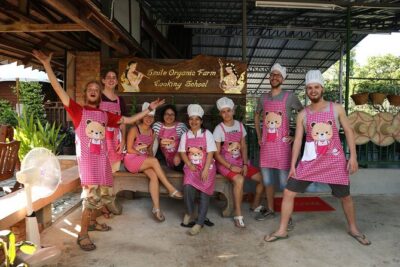
Half-Day Thai Cooking Class at Organic Farm in Chiang Mai
Read our review →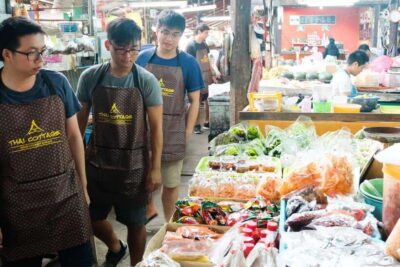
Cooking Class, Market & Thai Herbs Garden Tour
Read our review →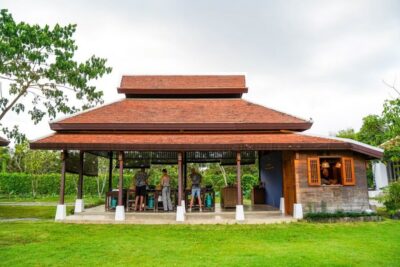
Authentic Cooking Class with Market & Farm Visit
Read our review →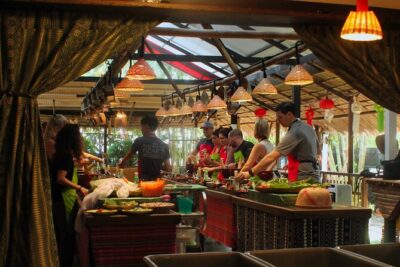
Browse the lists this tour appears in