
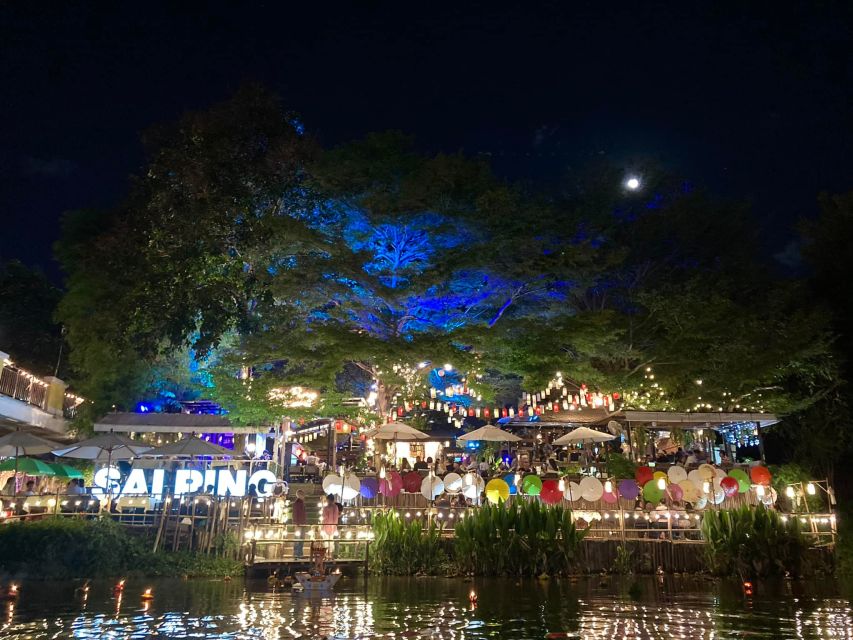
Reviewed · CANOES & KAYAKS
Chiang Mai: Ping River Night Kayaking into City Center
The best part of this Chiang Mai outing happens in the change from daylight to darkness. You begin near Wat Taa-Luk, where the Ping River feels quiet and rural, then float toward the city as bridges light up, restaurant music carries across the water, and Chiang Mai’s colors appear along the banks. The gentle current does much of the work, so you can enjoy the scene without treating the trip like a workout.
I like two things here: the unusual view of Chiang Mai from the water, and the calm shift from trees, bats, birds, and frogs to homes, restaurants, and glowing bridges. Guides including A, AJ, and Aidon have been praised for careful instruction and a good sense of humor. The main catch is that the first half can be quite dark, and the route does not reach far into the city center.
In This Review
- Key points to know before you book
- From Chiang Mai hotels to the Ping River
- Ten minutes to learn the kayak
- Wat Taa-Luk and the quiet start
- The six-kilometer route into Chiang Mai
- Approaching Nawarat Bridge after dark
- Why the calm pace works
- What to wear and bring
- Is $50 a fair price?
- Who should book this evening paddle?
- Booking details that matter
- Should you book the Ping River night kayak?
- FAQ
- How long does the Chiang Mai night kayaking tour last?
- How far do you kayak?
- Where does the kayaking begin?
- Where does the route finish?
- Is the activity suitable for beginners?
- Are children allowed to join?
- What equipment is included?
- What languages do the guides speak?
- Is hotel pickup included?
- Can I cancel the booking?
Key points to know before you book

- A 6-kilometer evening paddle: The route follows the Ping River from Wat Taa-Luk toward Nawarat Bridge, with help from the current.
- Two different river moods: The trip begins among trees and wildlife, then becomes more urban as restaurants, homes, music, and lit bridges appear.
- Good for beginners: A safety briefing, stable hard-shell kayaks, and an escorting instructor make this suitable for all endurance levels.
- A small-group feel: Past outings have included groups as small as three people, though the exact group size can vary.
- Bring clothes you can dirty: Low water can make the walk to the riverbank muddy, and light-colored clothing is a poor choice.
- Included for $50: Hotel pickup and return, equipment, safety gear, bottled water, insurance, and the river fee are part of the price.
From Chiang Mai hotels to the Ping River
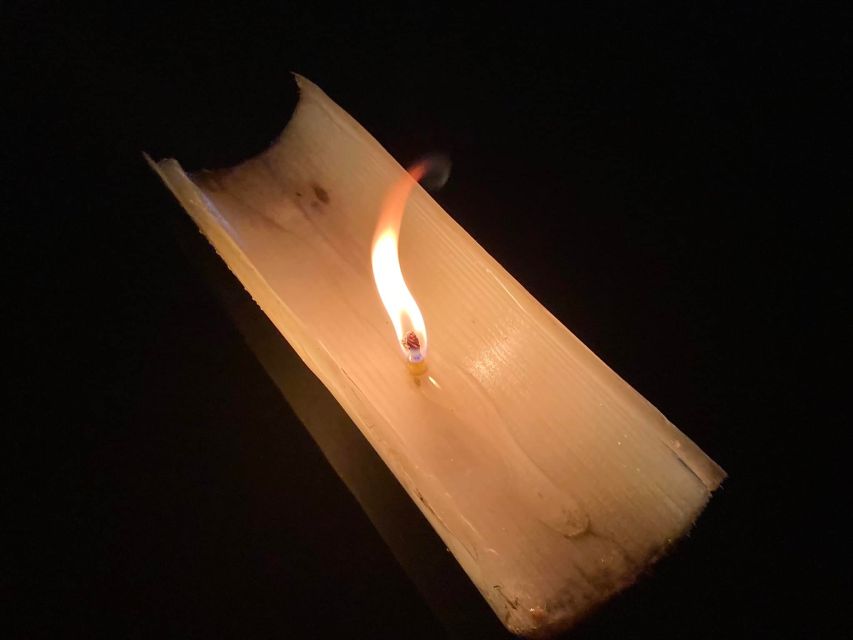
Pickup takes place in Chiang Mai between about 5:45 and 6:00 PM, depending on your location. The provider may make several stops, so allow some flexibility rather than planning a tight dinner reservation immediately after the tour.
The drive to the kayaking base takes roughly 15 minutes by jeep or SUV. That short ride matters because you leave the city before getting on the water. Instead of launching beside the busiest central streets, you begin near Wat Taa-Luk, where the river has a quieter feel.
The vehicle returns you to Chiang Mai after the paddle, with another drive of about 15 minutes. Hotel pickup and drop-off are included, which adds real value in the evening. You do not need to arrange a ride to an unfamiliar launch point or find a taxi after getting wet.
A few more Chiang Mai half-days to weigh up
- No.1 Full-Day Chiang Mai Caving & Jungle Kayaking: Chiang Dao
★ 4.5 · 206 reviews - Chiang Mai : Kayak the Jungle Rivers of Chiang Dao Valley!
★ 5.0 · 89 reviews - Chiang Mai:Explore kayaking through Mae Ping River on sunset
★ 4.6 · 76 reviews
Ten minutes to learn the kayak
At Chiang Mai Mountain Biking & Kayaks, the guide gives a safety briefing of about 10 minutes. You learn how to handle the kayak and receive basic instructions before heading to the river.
That short lesson is one reason the activity works for beginners. Several people who expected two hours to feel tiring found the time passed quickly, and the gentle current reduces the effort needed to keep moving. The guide also checks that you feel comfortable before the group sets off.
You use a hard-shell single or double kayak. Personal flotation equipment, a head lamp, safety lights, and a whistle are included. Bottled water is also provided, along with insurance and the river fee.
A good guide makes a real difference after sunset. The team has included guides known as A, AJ, and Aidon, while Jo Jo has handled driving on some outings. The strongest part of the guiding style is practical: clear instructions, attention to comfort, and steady support for first-time paddlers.
Wat Taa-Luk and the quiet start
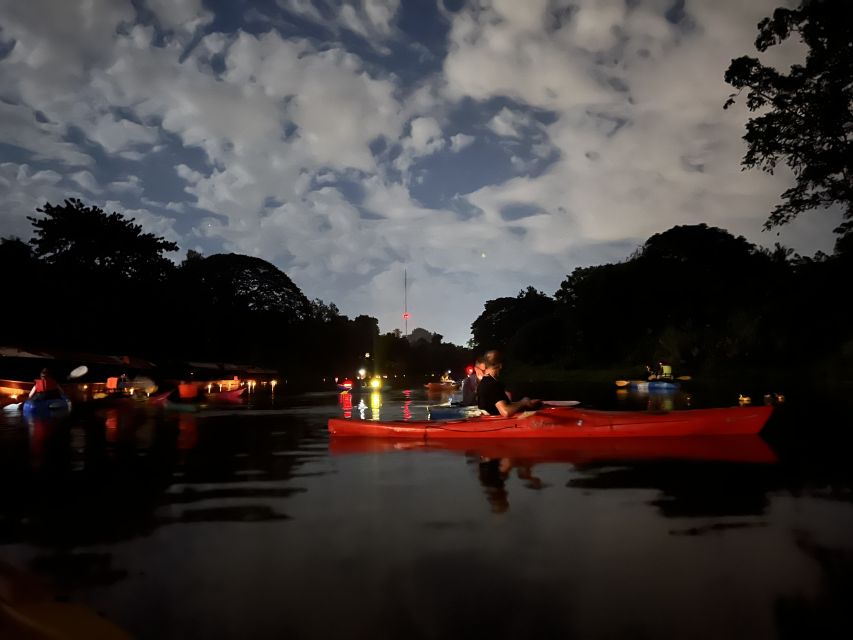
The launch at Wat Taa-Luk begins the two-hour kayaking section. At dusk, you can still make out the banks and trees, but the light fades as the boat moves downstream.
This opening section is not packed with sights. That is part of its appeal, but also something you should understand before booking. The river can feel very dark at first, with the sounds of wildlife doing more work than the city lights.
Large Mai Yai trees grow along the riverbank. Their size and position beside the water give this part of the route a natural frame, especially when the sky is dark and the banks are hard to see. You might hear frogs and birds, and bats have been spotted flying near the kayaks. One outing even had an owl close by.
The river is described as quiet and still, with a mild current that carries the kayaks downstream. You still paddle, but this is a relaxed trip rather than a test of strength or speed. If you want whitewater, sharp turns, or a high-energy adventure, this is not the right choice.
For me, the value of this stretch is the pause it creates. Chiang Mai can feel busy during the day, yet here you hear water, wildlife, and the occasional movement of your paddle. The darkness also makes the first city lights feel more noticeable when they arrive.
The six-kilometer route into Chiang Mai
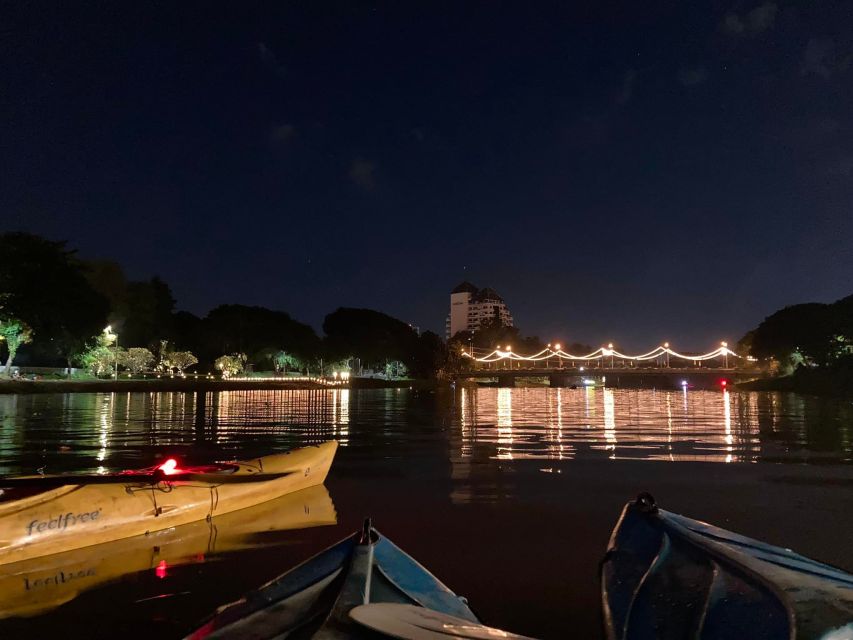
The full route covers about 6 kilometers and heads toward Nawarat Bridge. The river’s current helps the group move along, so you can concentrate on steering and looking around rather than covering every meter by force.
The route passes homes, restaurants, and riverside properties. These are not presented as formal sightseeing stops, and the guide may not identify every building. Instead, you see ordinary life from a low viewpoint that pedestrians and road traffic miss.
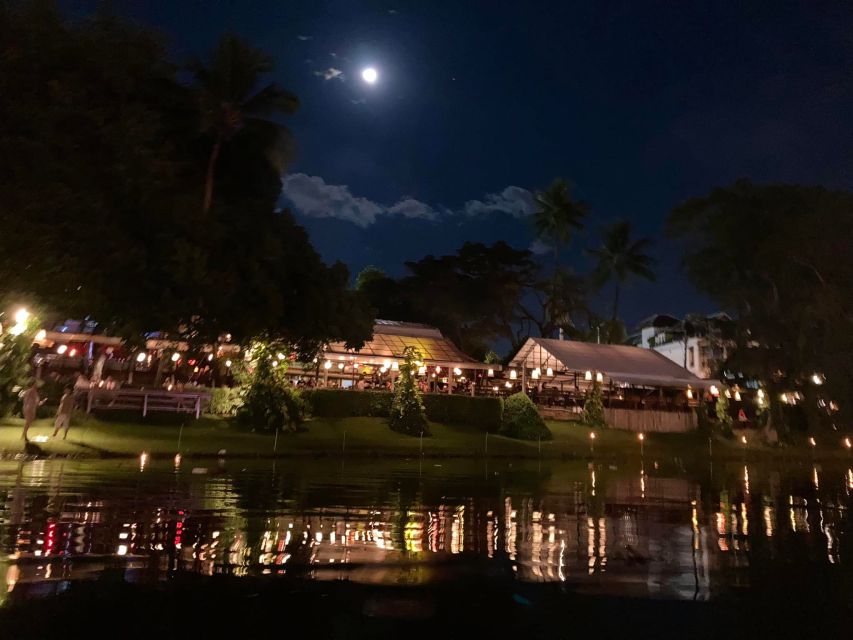
That perspective is the heart of the experience. A riverbank home can look entirely different from the water, especially at night when a small light or porch becomes the main feature. Music from cheerful riverside restaurants drifts over the river, adding a loose soundtrack without turning the trip into a staged show.
The guide can talk about Chiang Mai, the river, and the restaurants along the route. You also have time for conversation, which helps keep the evening personal, particularly when the group is small. The pace is slow enough to enjoy a full-moon reflection if the timing is right.
Same city, a completely different sort of day:
- Half-Day Thai Cooking Class at Organic Farm in Chiang Mai
★ 5.0 · 19,087 reviews - Chiang Mai: Elephant Sanctuary, Waterfall & Bamboo Rafting
★ 4.9 · 9,160 reviews - Chiang Mai: Doi Inthanon National Park Eco-Friendly Tour
★ 4.6 · 6,667 reviews - Chiang Mai: Elephant Sanctuary & Waterfall Group Tour
★ 4.9 · 5,780 reviews
Approaching Nawarat Bridge after dark
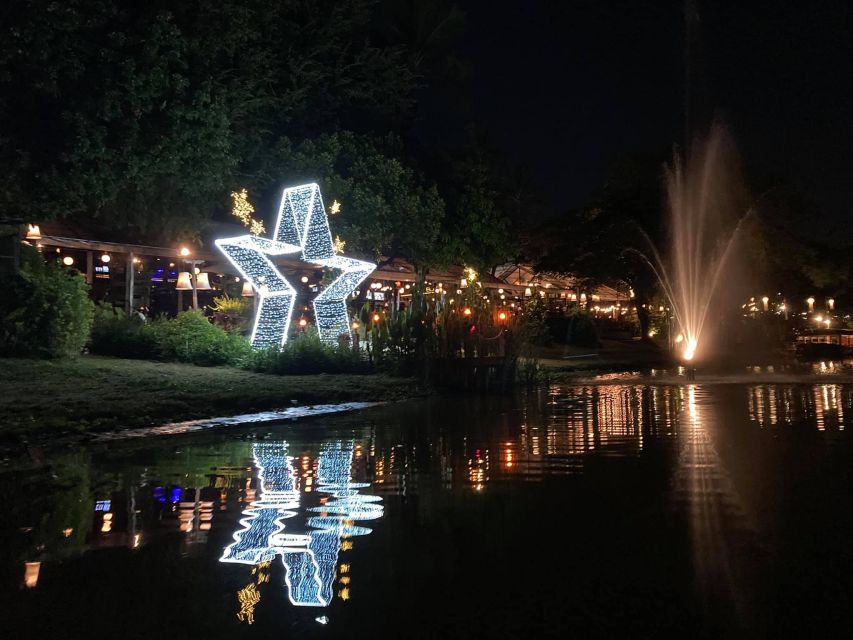
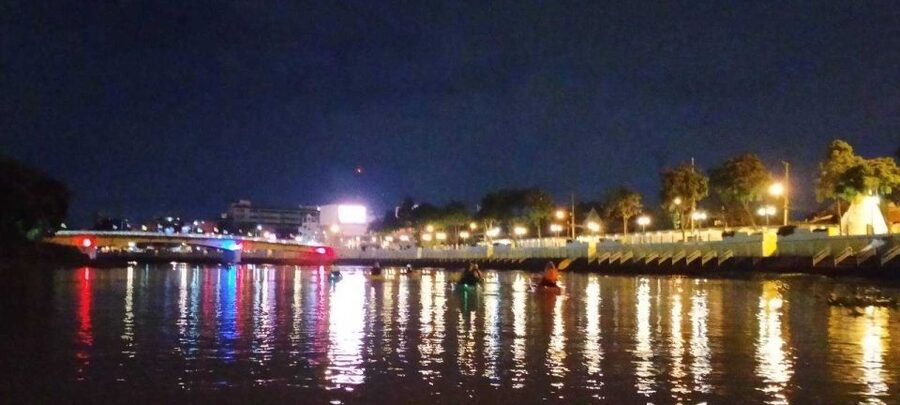
As the route moves closer to the city, the scene becomes more colorful. Bridges are lit in different colors, and the lights reflect on the Ping River. Restaurants and nearby buildings add more points of brightness along the banks.
Nawarat Bridge marks the city-side end of the kayaking route. This is not a full nighttime tour of central Chiang Mai from the river. One important limitation is that you do not travel far into the city center, so the phrase city kayaking should be understood in a modest way.
Still, the change from the dark, wooded opening to the lit urban section is satisfying. You get two settings in one short trip: a peaceful river outside the central area and a gentle glide past the city’s evening activity.
The route can look especially pretty during a festive period, when restaurants or seasonal decorations add extra lights. Outside those dates, the view will depend on the businesses and homes along the bank. If you need a constant wall of illuminated sights, you may find the urban section too brief.
Why the calm pace works
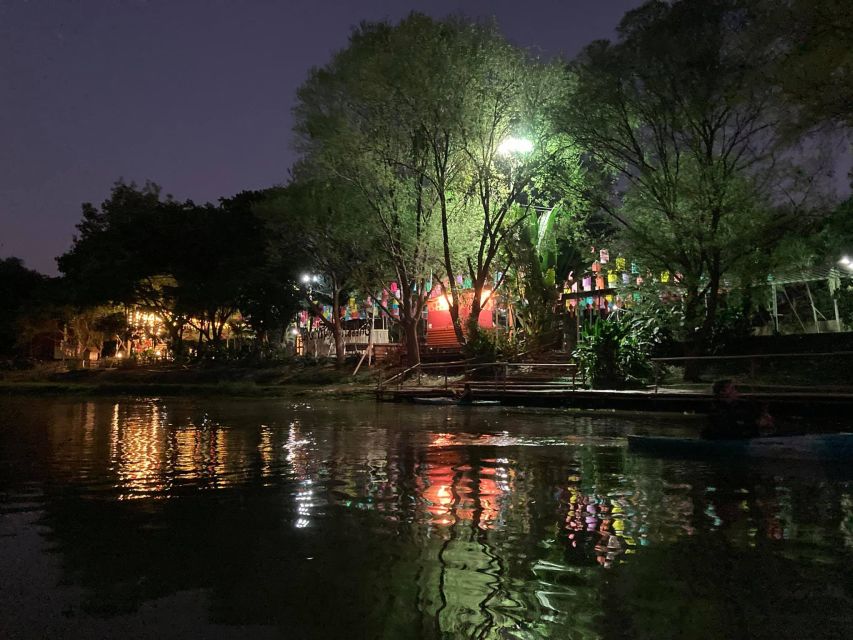
The most praised feature of this activity is the atmosphere. People describe it as peaceful, relaxing, therapeutic, and joyful. That pattern makes sense once you understand the route: the current is gentle, the river is quiet, and there is no demand to race from one attraction to the next.
You can stop paddling for a moment and listen. In the darker stretch, that may mean bats, frogs, birds, or the soft movement of water. Near the restaurants, it may mean music and voices floating across the river.
The guide remains nearby and watches the group. This is especially helpful if one person is new to kayaking or is less confident at night. A first-time paddler has extra reason to appreciate the patient pace and clear safety support.
The activity also suits couples and families looking for something different after a day of temples and markets. Children under four cannot join, but the gentle water has worked well for older children on family outings. The provider says the activity suits all endurance levels, though you should still be comfortable sitting and paddling for two hours.
What to wear and bring
Wear clothing that can handle splashes and mud. If the water level is low, reaching the river’s edge may involve a muddy walk. Light or cream-colored clothes are a bad match for that possibility.
Bug spray is a smart addition, particularly because the trip passes through a natural, tree-lined area after sunset. One outing had no bugs, but conditions can vary, and the riverbank is an outdoor setting.
The provider supplies a head lamp and safety lights, but you may still want to bring only items you can secure. A phone is useful for photos, yet night kayaking is not the time to hold loose valuables over the water.
You receive bottled water, and the essential safety equipment is included. There is no need to bring your own kayak, paddle, flotation device, whistle, or river permit.
Is $50 a fair price?

At $50 per person, this is not the cheapest evening activity in Chiang Mai. You can find inexpensive ways to spend two hours in the city. The price makes more sense when you count what is included: hotel transport in both directions, a safety briefing, a single or double hard-shell kayak, safety equipment, a professional instructor, bottled water, insurance, and the river fee.
The experience is also more specialized than a standard city walk. You are paying for access to a river route and for the support needed to use it safely after dark. If you value quiet scenery, a small-group atmosphere, and a memorable change of pace, the cost is reasonable.
The value is weaker if your main goal is a long tour through Chiang Mai’s most famous central sights. The route approaches Nawarat Bridge but does not carry you far into the heart of the city. You are paying for the river setting, not a packed sightseeing schedule.
Past outings have included small groups of three and private-feeling experiences for couples, though group size is not specified as fixed. If your booking happens to be small, the guide’s attention and conversation add to the value.
Who should book this evening paddle?
I would recommend it to beginners, couples, families with children over four, and anyone who wants a quiet evening outside the usual restaurant and market routine. You do not need strong endurance, and the gentle current means the activity does not demand serious athletic ability.
It is also a good fit if you enjoy natural sounds and changing scenery. The route gives you trees, Mai Yai trunks, wildlife, houses, music, bridges, and reflections within two hours.
You may want to skip it if you dislike darkness, mud, insects, or sitting in one position for an extended time. It is also not ideal if you want a dramatic night skyline or a detailed sightseeing narration at every bend.
The guides can share local information and keep the mood light, but this is primarily a paddle with conversation, not a formal history tour. You should expect a peaceful ride rather than a list of monuments.
Booking details that matter
The activity lasts two hours, with start times shown according to availability. Pickup normally runs from 5:45 to 6:00 PM, though the exact time depends on your hotel and the number of stops.
English, German, and Thai-speaking guides are available. You can cancel up to 24 hours in advance for a full refund, and the reserve-now, pay-later option allows you to hold a place without paying immediately.
The age restriction is simple: children under four cannot take part. The activity is otherwise presented as suitable for all endurance levels, with single and double kayaks available.
Should you book the Ping River night kayak?
Book it if you want to see Chiang Mai at a slower pace and enjoy the transition from rural riverbank to city lights. The gentle current, careful instructors, wildlife, music, and colorful bridges create a memorable evening without demanding much physical effort.
Do not book it expecting a long cruise through the central skyline. The first half may be mostly dark, and the route reaches only partway into the city. At $50, the tour is best value for people who care more about atmosphere and an unusual viewpoint than a packed list of landmarks.
FAQ
How long does the Chiang Mai night kayaking tour last?
The kayaking activity lasts two hours. Including the short vehicle rides to and from the river, you should allow more than two hours overall.
How far do you kayak?
The route covers about 6 kilometers along the Ping River, with help from the current.
Where does the kayaking begin?
The kayaking begins at Wat Taa-Luk, after transport from Chiang Mai and a safety briefing at Chiang Mai Mountain Biking & Kayaks.
Where does the route finish?
The route heads toward Nawarat Bridge before the vehicle returns you to Chiang Mai.
Is the activity suitable for beginners?
Yes. The provider says it suits all endurance levels, and the tour includes instruction, stable hard-shell kayaks, and an escorting kayak instructor.
Are children allowed to join?
Children under four are not allowed to participate. The provided information does not specify an upper age limit.
What equipment is included?
You receive a hard-shell single or double kayak, a personal flotation device, a head lamp, safety lights, a whistle, and bottled water.
What languages do the guides speak?
The live guides speak English, German, or Thai. Guides on different departures may vary.
Is hotel pickup included?
Yes. Pickup and drop-off in Chiang Mai are included. Pickup is generally between 5:45 and 6:00 PM, depending on your location, and several stops may be made.
Can I cancel the booking?
You can cancel up to 24 hours in advance for a full refund. The reserve-now, pay-later option lets you book without paying at the time of reservation.
Just added around Chiang Mai
- Chiang Rai Wonders: White, Blue & Red Temples and Hot Spring★ 5.0 · 3 reviews
- Chiang Rai White Temple Blue Temple and Hill Tribe Village Tour★ 3.5 · 3 reviews
- Private Chiang Mai City Tour including Wat Doi Suthep, Wat Suan Dok (SHA Plus)★ 5.0 · 3 reviews
- Workshop Making Herbal ball & herbal inhaler★ 4.3 · 3 reviews
- Chiang Mai Mae Ping River Cruise and Thai Farmer House Visit★ 4.0 · 3 reviews
- Phoenix Zipline Adventure Park – Chiang Mai Thrills★ 4.0 · 3 reviews
- Monk trails hike, Wat Phalat, Monk chanting, Wat Doi Suthep.★ 5.0 · 3 reviews
- Tok Sen Massage at Fah Lanna Spa in Chiang Mai★ 4.5 · 3 reviews
Canoes & Kayaks, compared.

No.1 Full-Day Chiang Mai Caving & Jungle Kayaking: Chiang Dao
Read our review →

Explore kayaking through Mae Ping River on sunset
Read our review →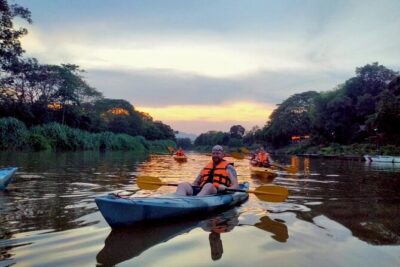
Kayak Under the Stars – 6 km to the Heart of the City
Read our review →
Chiang Mai Biking & River Kayak : Gentle Thrills in a Lush Valley
Read our review →
No.1 Chiang Mai: Leisure River Kayaking: Mae Taeng forest Reserve
Read our review →

Browse the lists this tour appears in